* required field

“Why can’t I just highlight? Why do I have to annotate?” Ever heard this from a student? I don’t have to convince you of the value of annotating, but we do need to remind (and even persuade) students that annotating a source can help us monitor for meaning. Annotating can help us make sense of …Read more
Co-written with Dr. Julie Webb and originally published at middleweb.com. Is the term “gradual release of responsibility” misleading? Especially when we explain GRR with phrases like “I DO, WE DO, YOU DO”? Terms like these position the teacher as leader of the learning, in control of the learning process. In truth, though, we want students …Read more

It never fails. With some students, you can have the best time analyzing and talking about an informational source, but when they go to write a short response, they lose their grounding and start to fall. How do we help students bridge the gap between reading and writing? In our practice, making a plan for a written …Read more

If your students struggle with determining what’s important or they think “It’s all important!” make sure they have a clear purpose for reading. A purpose stated as a question is even better. Questions like “What is the author’s point of view? What are details in the sources that make me think so?” or “How did …Read more
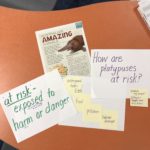
It’s frequently true. We have grand conversations about engaging nonfiction and then when our students write in response…well, the struggle is REAL. Here are some approaches I’ve found helpful in grades 2-6 — Just a few thoughts on #1-3. 1) Provide a clear purpose for writing. Students need an audience (other than you). As much …Read more

Three books about Justice Ruth Bader Ginsburg. Three different authors. Each shape the facts to reveal distinct insight. Here are two examples of how the authors address the same part of Ginsburg’s life in different ways. 1. As a child, Ruth’s love of reading 2. Ginsburg’s landmark case in front of the Supreme Court for …Read more
Do you have students who blow through texts? Getting the gist, but not really thinking through specific details that might make a difference in their understanding? Help them slow down by conferring about just a small part of the text–an important word, phrase, sentence. Sample conference When I leaned in to confer with a student, …Read more

During conferences, while I do listen to what students are saying, I also listen for what they are NOT saying. This is why. Frequently when you ask a student to tell you what they have learned from a complex informational source (or a part of a source), they will talk about content they understood without …Read more

When I lean in for a reading conference with a student reading an informational source, I always start with “Tell me what you learned in this section. In the case of narrative nonfiction, I ask, “What just happened in this section of the text?” When I do this, I’m checking for within or “right there” …Read more

When we realize a student does not understand a complex chunk of text, we may need to stop asking questions for understanding and “think aloud” for the student, modeling how to make sense of the text. What follows is an excerpt from a middleweb.com column “Letting Go is Messy” that I co-wrote with Julie Webb …Read more