
Are your students regurgitating facts from a text without really thinking about main ideas? When you ask about the main idea of a text (or section), do you get a shrug? What follows is a description of a conference I held with a student in which we explore what the main idea is in a particular part of the text.
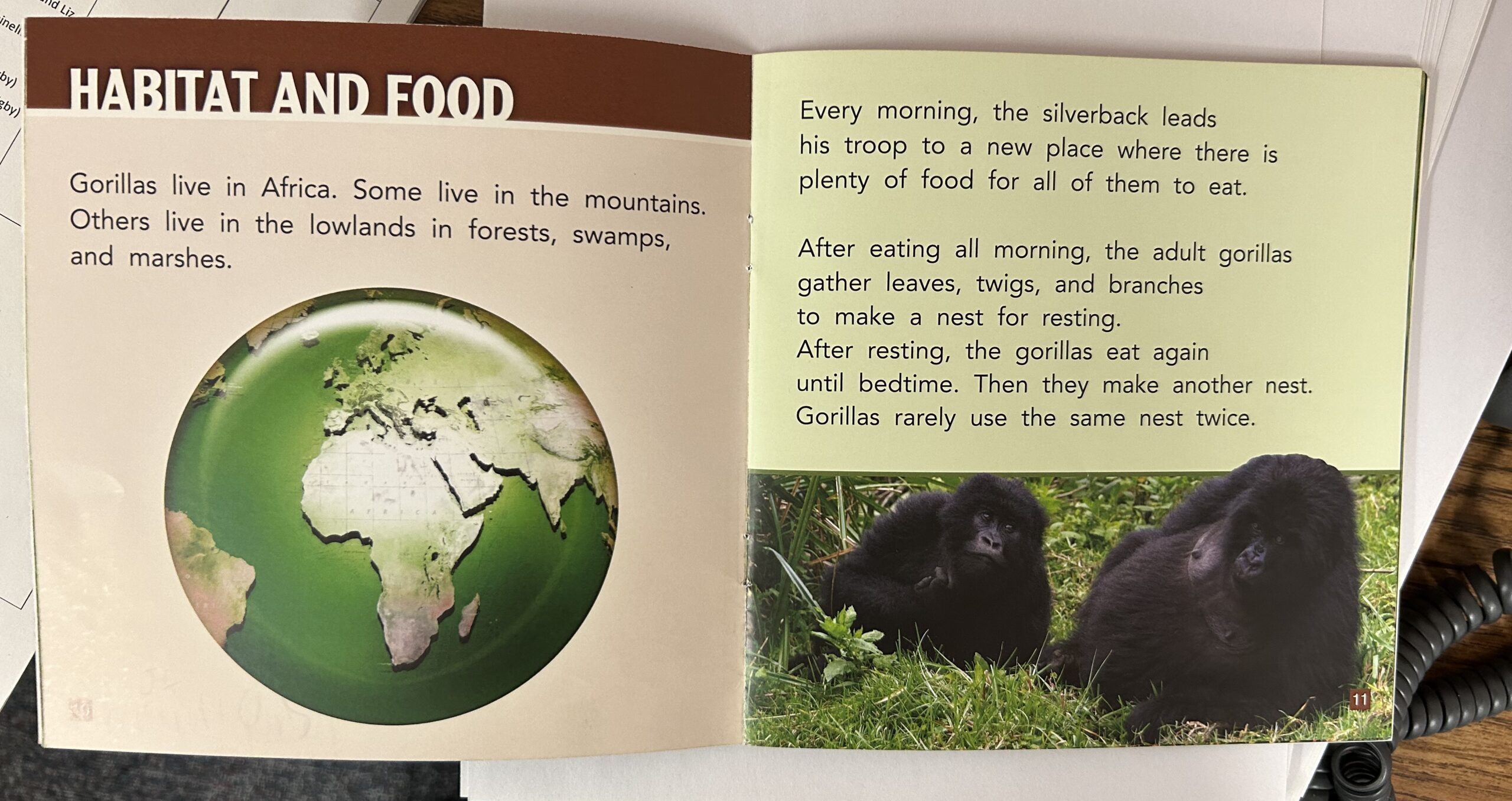
Move #1 I assessed by asking, “What did you just learn?”
Teacher (Me): So what did you learn on this page?
Student: The gorillas eat all morning and then make a nest to rest. Then they eat again and make another nest because they don’t use the same nest twice.
The student’s response revealed a good recall of the details in the excerpt he’d just read. It was tempting to say “good job” and move on to the next student. Instead I affirmed the student with a behavior specific praise that sounded like, “Sounds like you are monitoring for meaning and remembering several key details in the text.”
The conference was still not over, though. I have to find a teaching point.
Move #2 I assessed further by asking “What’s the main idea?”
Teacher: What’s the main idea on this page then?
Student: [Shrugs.]
YAY!!! A place to teach at the point of need is revealed!!!
Move #3 I thought aloud as a model reader
Teacher: Would it be okay if I show you how I figured out the main idea? [Student nods.] I noticed the author describes what the gorillas do every day in their habitat. There’s a sequence. For example, the author uses the phrase “every morning” at the beginning of this page. Are there any other clues that the author is doing this? [Then I drew the student into thinking about phrases like after eating, after resting, until bedtime and the word again.]
Teacher: This is a text structure! When I noticed the author’s text structure of sequencing, I started to realize that these details are related or connected in that they describe the gorilla’s daily routine. The gorillas do these things every day sort of like humans have things they do every day. How is their routine like ours as humans? [Student responds with a few comparisons.] So what’s the author’s main idea here?
Then the student and I thought aloud together about possible main ideas like:
- Gorillas have a daily routine in their habitats.
- Gorillas have a daily routine just like humans.
- Gorillas rely on their habitat every day for essentials like food and materials to make their nest.
Thinking beyond the text like this can help the student understand better why the gorilla’s habitat being destroyed (as described later in the book) has serious consequences for the gorillas who have daily routines that require a stable habitat.
Move #4 I made the teaching point clear
At the end of the conference, the teaching point sounded like the following: So when you’re reading a nonfiction book like this, it’s not enough to just notice and recall the facts. You need to be thinking about why the facts you’ve learned are important. How are they all connected? What’s the bigger idea? Doing this kind of work can help you remember the text better and it can change your view of the world, too!
Okay…I did most of the work here – a heavy I DO. What’s key is coming back to this student over time and having additional conferences in response to “What’s the main idea?” As described in a previous post, a key resource for these repeated conferences could be an anchor chart that explains clearly what students need to do to identify a main idea like the one below. (You might carry a small version of this with you and refer to it as you discuss your teaching point.)
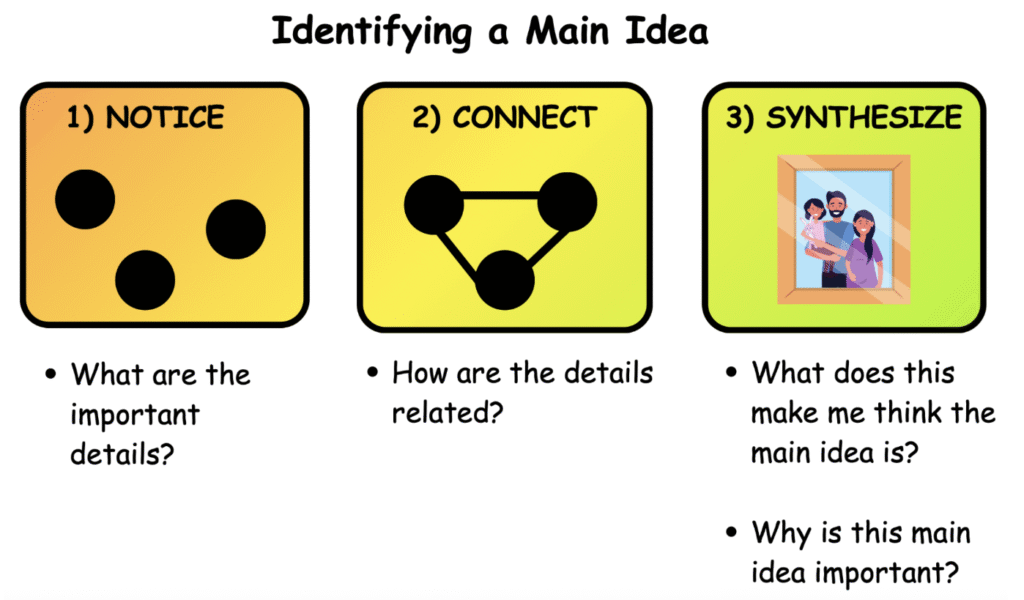
It was messier than this 😉
Honestly, the conference I described here was messier than I’ve made it out to be! On the spot coaching is hard! Don’t be afraid to push your students, though. And know that sometimes our fear of this kind of conversation with students is because we ourselves don’t know the main idea of a section of text. If you’re not sure of the main idea, be willing to take a moment to think for yourself or to think aloud and ponder with the student – in other words, to muddle a bit! It’s that important!!!
Hope this helps.
S
Revisited 8/5/2025
Revised and reposted 2/2/2026
Image by Freepik