* required field
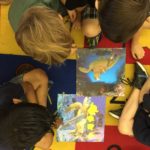
I’m exploring how we can help young students “identify basic similarities in and differences between two texts on the same topic” (Common Core standard RI K.9). In two lessons I gave with kindergarten this week, I focused on the language “we can use to describe sea turtles.” I chose this topic because these students are …Read more
I tried something new–I provided a list of “key details” from a section of text as a way for students to review content before engaging in close reading of a more difficult section of the text. During a previous lesson, the 3rd grade students had read an article about Dolores Huerta (in the McGraw-Hill Wonders …Read more
In the last blog entry, I shared a rigorous text set and prompt developed by an middle school ELA team. The team and I met (via Webinex) to discuss the students’ written responses. First we look at the strengths of each student’s analytic essay; then we discuss the students’ needs as writers. Integrated into this …Read more
Kudos to my ELA colleagues in a middle school who developed this appropriately rigorous text set and prompt for their 8th grade students studying the Holocaust. Together with the 6th and 7th grade teams, we analyzed several students’ written responses to this prompt. More on that in the next post 🙂 TEXTS: Source A (entire …Read more
Is the term “key details” vague for your students? I’m teaching 2nd/3rd grade students this week and trying out an anchor chart that attempts to make the term “key details” more concrete for students. I think a “key detail” might change depending on what our purpose is for reading. Here are a few of the …Read more
I had the honor of teaching a small 2nd grade group of students a guided writing lesson after we had done a guided reading lesson with an excerpt from an A to Z text, George Washington Carver, Level O. In a previous post, I wrote about the first lesson – close reading of an excerpt …Read more
Last week I gave a close reading lesson with an excerpt from an A to Z text, George Washington Carver, written at Level O. (See my previous post “Tips for using A to Z texts for close reading”.) Our text-dependent question was, “What did Carver achieve?” This seems like an easy question at first, but …Read more
Reading A to Z is a common classroom resource for leveled informational texts. There are some good texts in this collection – I would just be cautious, read for quality, and choose with clear objectives or text-dependent questions in mind. Below I describe how a group of teachers and I chose excerpts from Reading A …Read more

I’ve been thinking about how we can help students identifying multiple main/central ideas in a text. Traditionally we’ve focused on identifying one main idea, but beginning in 5th grade (and continuing in 6th and 7th), the Common Core Standards for Reading Informational Texts expect students to be able to “determine two or more main ideas …Read more
Recently I taught a lesson with sixth grade students reading two texts on the topic of Hurricane Katrina. While the authors of both texts had the same purpose–recounting events that occurred when the storm hit land, the authors used different text structures to convey the content. The first text was primarily a timeline of what …Read more