
As teachers, we come across lots of words our students don’t know—far more than we could possibly teach. In Part 1 of this series, I shared a five-step routine for introducing new vocabulary: Analyze, Define, Associate, Connect, and Link. Before we can use that routine, though, we have to decide which words are worth teaching.
A good place to start is with words students will encounter and use repeatedly throughout a lesson, series of lessons, or unit. These repeated opportunities can help students get to know the words well and begin using them independently. The four categories below can help you create a list of essential vocabulary. You can also download this handout to use as you plan.
1. Skills and strategies
Choose vocabulary related to the skills and strategies you are teaching. Start by looking at the overview or title of the unit. What terms will you use repeatedly that students may not fully understand? In a first-grade unit on understanding informational texts, students may need to understand terms such as main topic and key details. In a fourth-grade unit on interpreting characters, words such as synthesize, envision, and develop may be essential. These words can be easy to overlook because they are so familiar to us, but students need to understand them to follow the instruction and talk about the work they are doing.
2. Strategic thinking
Choose vocabulary students can draw on to think and talk about texts strategically. Consider the kind of thinking students will be asked to do. If they will be discussing character traits, they may need words such as perseverant, tenacious, ambitious, altruistic, arrogant, or compassionate. If they will be discussing theme, words such as reveals, suggests, demonstrates, and illustrates can help them explain what the evidence shows. Select just a few words that will help students express more precise and complex ideas.
3. Mentor texts
Choose vocabulary that relates directly to the mentor texts students are reading. Some words may appear in the text and be important for understanding a critical event or idea. Other words may not appear in the text but can help students name a theme, main idea, feeling, character trait, or larger concept. For example, in a Newsela article about the discovery of the Tilcayo wildcat, species appears repeatedly and is essential to understanding the text. Conservation does not appear, but it helps students discuss the larger idea of protecting the Tilcayo and the forest it depends on. Students might use both words to explain that identifying the Tilcayo as a separate species may lead to greater conservation efforts.

4. Connectives
Choose connectives—words and phrases that help students express relationships between ideas. These words do not have to appear in the mentor text; select them based on the kind of thinking students will be doing. For example, students might use because to explain why the Tilcayo may be endangered or however to contrast the importance of its discovery with the threats it faces. Teaching connectives such as because, meanwhile, however, and as a result can help students communicate their thinking more clearly during discussion and in writing. See this list of common connectives for additional possibilities.
Keep the list manageable
These four categories are places to look—not a checklist that requires you to choose words from every category. A word may fit into more than one category, and some categories may be more important than others in a particular unit. The goal is to create a manageable list of words students will encounter and use repeatedly as they read, think, talk, and write. Those repeated opportunities are what help students make the words their own. Once you’ve identified a manageable set of essential words, you’re ready to introduce them using the five-step routine from Part 1.
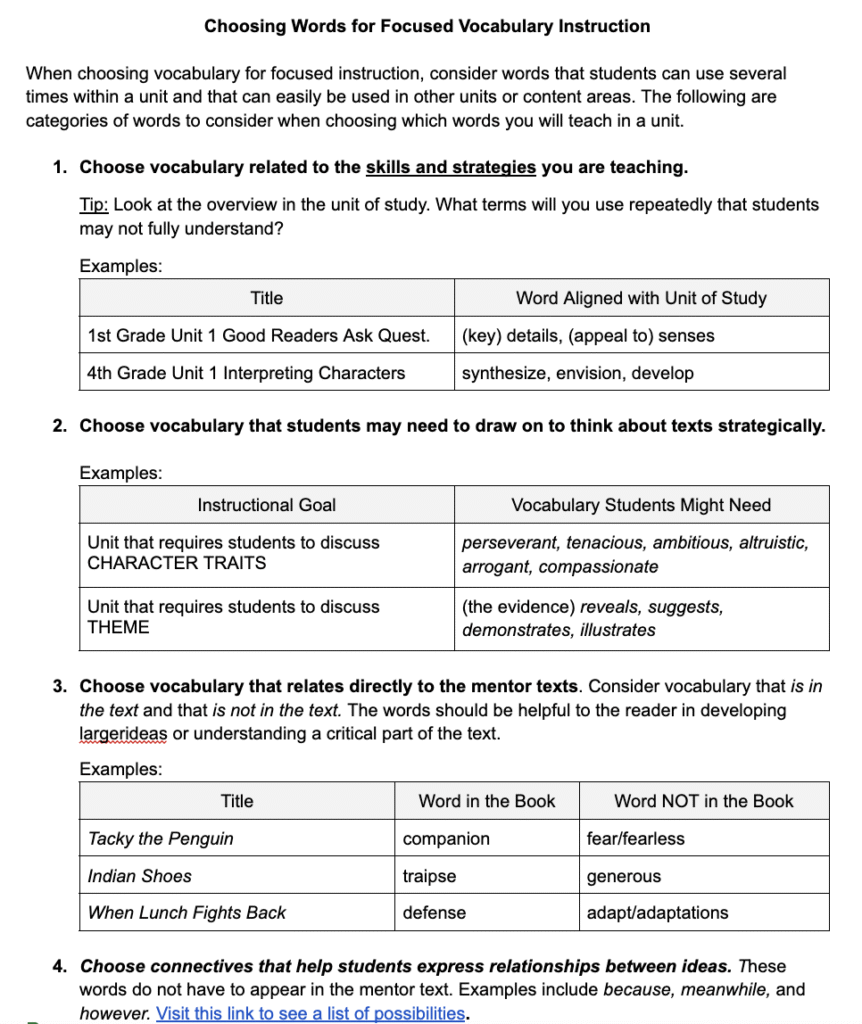
Download the one-page handout for help choosing words for focused vocabulary instruction.
Hope this helps.
S