
Introducing a new vocabulary word is only the beginning. Even when students understand a word during the initial lesson, they need repeated opportunities to retrieve its meaning, hear it in new contexts, and use it as they talk and write. Without this review, even a carefully selected and thoughtfully introduced word may not stick.
In Part 1 of this series, I shared a five-step routine for introducing vocabulary. In Part 2, I described four categories teachers can draw from when choosing words to teach. In this final post, I’ll share three quick ways to revisit one or several words during follow-up lessons. Each can be completed in just a few minutes while giving students another meaningful opportunity to make the words their own.
1. Thumbs Up, Thumbs Down
Share examples and nonexamples of situations in which the word might be used. Ask students to show a thumbs-up if the word applies and a thumbs-down if it does not. For the word optimistic, you might ask:
- If I don’t think my mom will order pizza tonight, am I feeling optimistic?
- If I practice basketball every day, might I feel optimistic about making the team?
- If I never practice running, should I feel optimistic about making the track team?
After each response, ask students to explain their thinking to a partner. Then invite one or two students to share with the class. Repeat the process with several target words, mixing examples and nonexamples for each. The thumbs give every student an easy way to respond, but explaining why an example fits—or does not fit—is what deepens their understanding of the word.
2. Partner Review
Post the definition and sentence frame used to introduce the word. Ask partners to take turns paraphrasing the definition and using the word in an example. After one partner shares, the other should respond before offering an example of their own. You might provide response frames such as:
- “Your example shows what ___ means because…”
- “I agree because…”
- “Can you explain how your example connects to ___?”
For newcomers, consider using trios. This gives students an opportunity to listen to a model, rehearse the language, and then share.
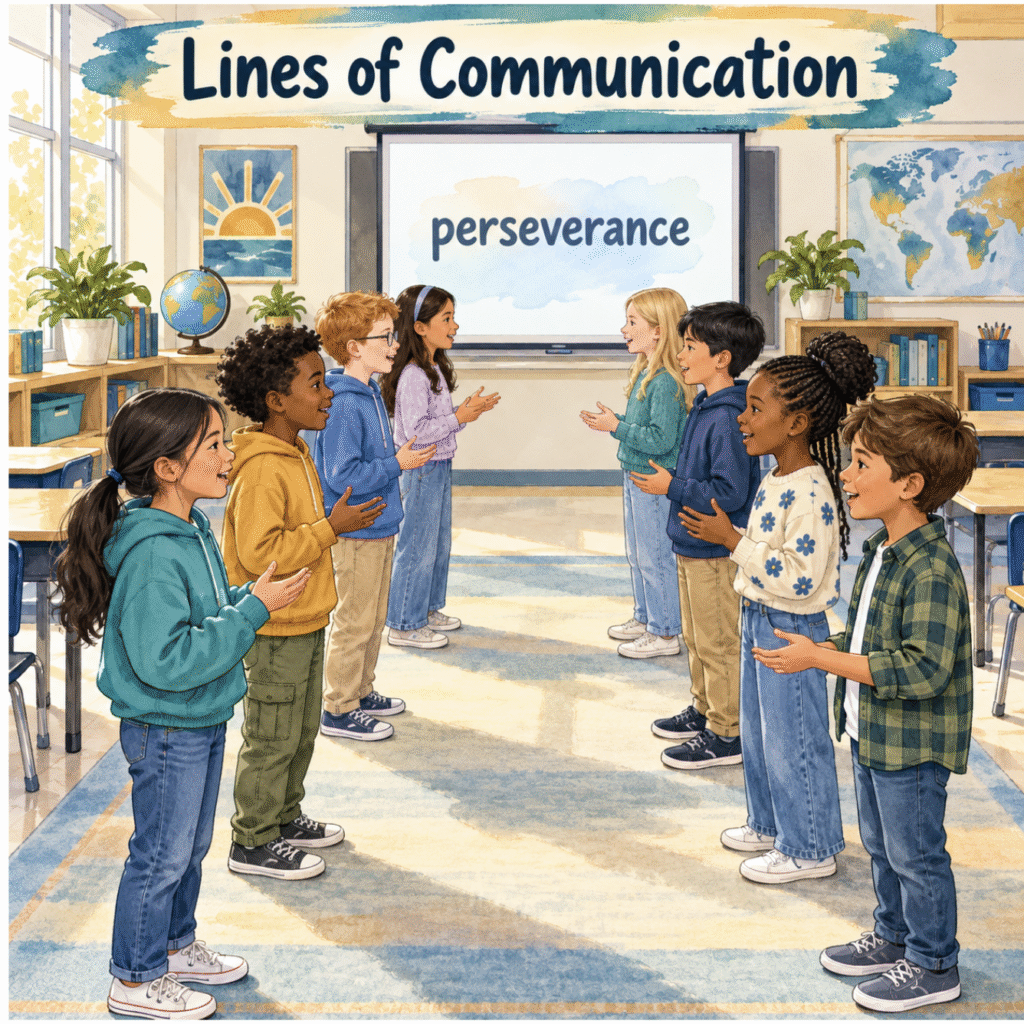
You can also use a Lines of Communication structure. Students form two lines and face a partner. Each student uses the target word in a sentence and responds to the partner’s example. After a short exchange, one line shifts so that everyone has a new partner. Ask students to create a new example during each exchange rather than repeating the same sentence.
3. Sentence Writing with Kid-Friendly Checklist
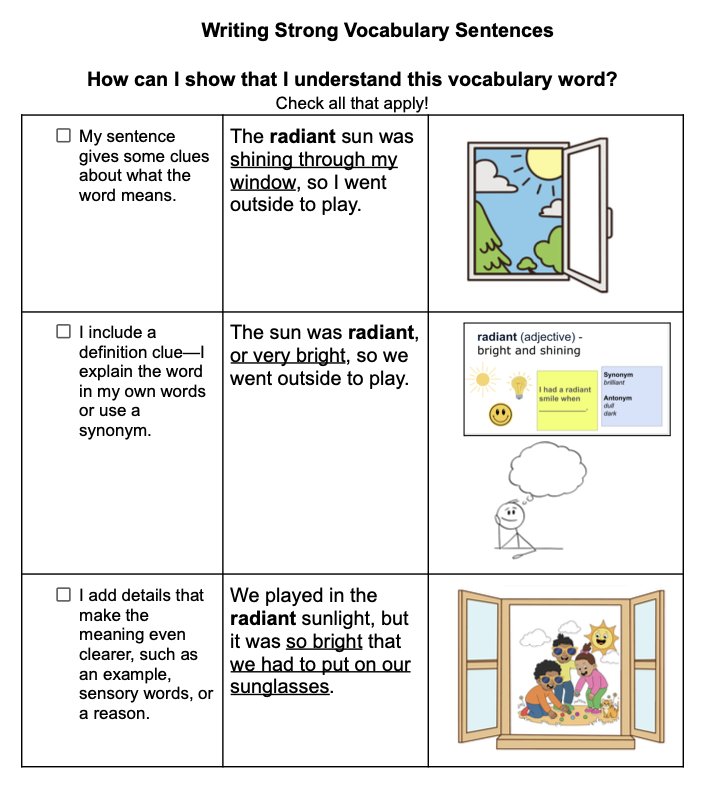
Ask students to write a sentence that makes the word’s meaning clear. A sentence such as I am optimistic uses the word correctly, but it does not reveal what the word means. Encourage students to include enough context for a reader to infer the meaning:
I practiced basketball every day, so I am optimistic that I will make the team.
Students can choose from several words you are reviewing. For an additional challenge, ask them to use two words in one sentence.
Students may need support learning how to add this kind of context. Invite them to include the word’s definition, a synonym, or details that make the meaning clearer. This kid-friendly checklist can help students evaluate and strengthen their sentences.
Use the Words Throughout the Day
These brief routines should not be the only times students hear or use the words. Look for natural opportunities to bring the words back throughout the day. You might say, “I’m optimistic that we’ll finish this project today,” point out when a student sounds optimistic, or ask whether a character in a text is feeling optimistic. Invite students to use the words during discussions and in their writing—and notice when they do.
Vocabulary review does not have to take a lot of time. The routines above provide focused practice, but students also need to encounter and use the words regularly in meaningful contexts. The goal is not for students to memorize a definition for a quiz. It is for them to understand the word, recognize it in new contexts, and use it independently.
You can download the Steps for Introducing Vocabulary handout for the five-step routine and these review ideas.
Hope this helps!
S