
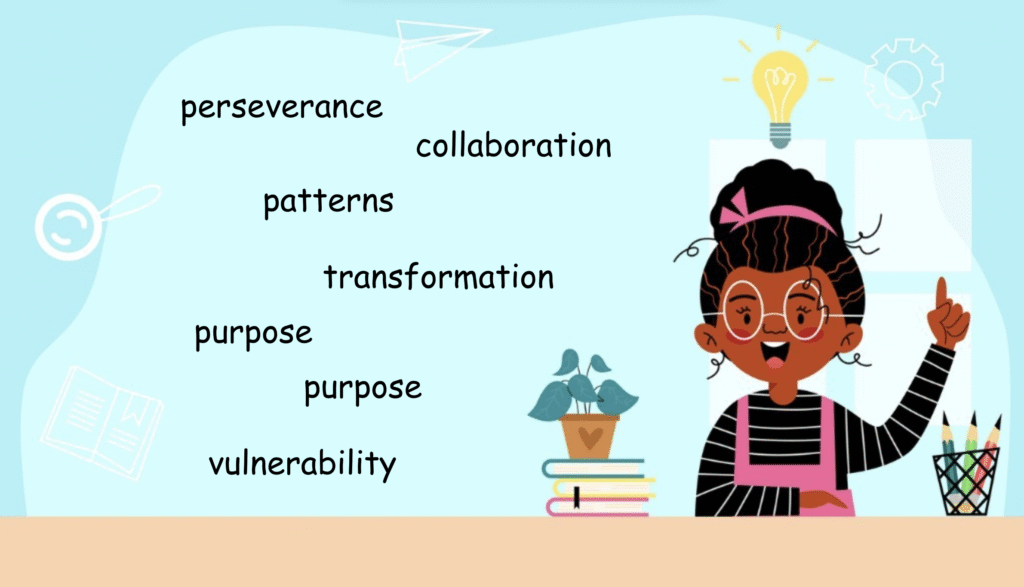
I don’t believe we should wait until the “unit on main idea” to teach this concept. Instead, every time we read an informational source with students, we should facilitate a discussion about the main ideas in that source. Why? Because the main idea is the soul of a source. Main ideas empower readers to –
- identify key details,
- hold onto a body of facts,
- build knowledge as they read additional sources – using main ideas as a lens for connecting, comparing, contrasting,
- and, most importantly, think critically (in new ways) about the world around them.
Honestly, all the strategies we’re teaching when we work with informational sources (like identifying author’s purpose, identifying key details, learning from text features) should be in pursuit of understanding the main ideas in the source. Author’s purpose is connected to the main idea they want to reveal. Key details connect to reveal a main idea. Text features can reveal a main idea. And on and on. If we want reading to be a transformative experience for our students, they need to be constantly asking, What are the main ideas in this source, ideas that may affirm, change, challenge how I see the world? This stance can our give students a real purpose for reading and learning and launch them into higher level/critical thinking.
Imagine the impact on learning if our students were able to strategically read an informational source and then make comments like the following:
- It was amazing what this group achieved because of their perseverance. It reminded me of…
- I was really inspired by the collaboration of the community members and the impact it had on their town as a result. It makes me wonder about….
- I think I understand better how each of the physical features of this animal has a clear purpose and contributes to its survival. That makes me want to learn more about…
- It’s incredible how understanding the patterns of nature can help us think about …. so now when…. I will be thinking about….
The BIG question is how fluent are we, as educators, in identifying a source’s main idea for ourselves? Easily recognizing (and naming) main ideas (in an entire source or sections of a source) can help us when teaching with specific texts and also when conferring with students during independent reading. And, frankly, main ideas can help us fall in love with a source and with teaching with informational sources (if you’re not already a fan like me ;).
I’ve developed an extensive (but not exhaustive) list of main idea words/phrases that can be used to create main idea statements. If you feel like you need to work on building your main idea fluency, my suggestion would be to consult a list like this when you are planning with a source. The ideas listed might spur your thinking.
This is the first in a three-part series about teaching the concept of main idea. In the next few weeks, I will post about how to explicitly teach the concept of main idea to students as well as how to confer about main ideas with students who are reading self-selected informational sources. If you want to get ahead, here’s a TWO-PAGE RESOURCE on teaching main idea that I’ll explain further in the next post.
Hope this helps.
S