Teaching students to identify the main ideas in a text is sometimes hard. The more explicit we can be, the better students will catch on. My key strategies for teaching main idea include the following…
- Stating clearly what a main idea is (and how there can be more than one in a text)
- Stating why understanding the main idea is helpful
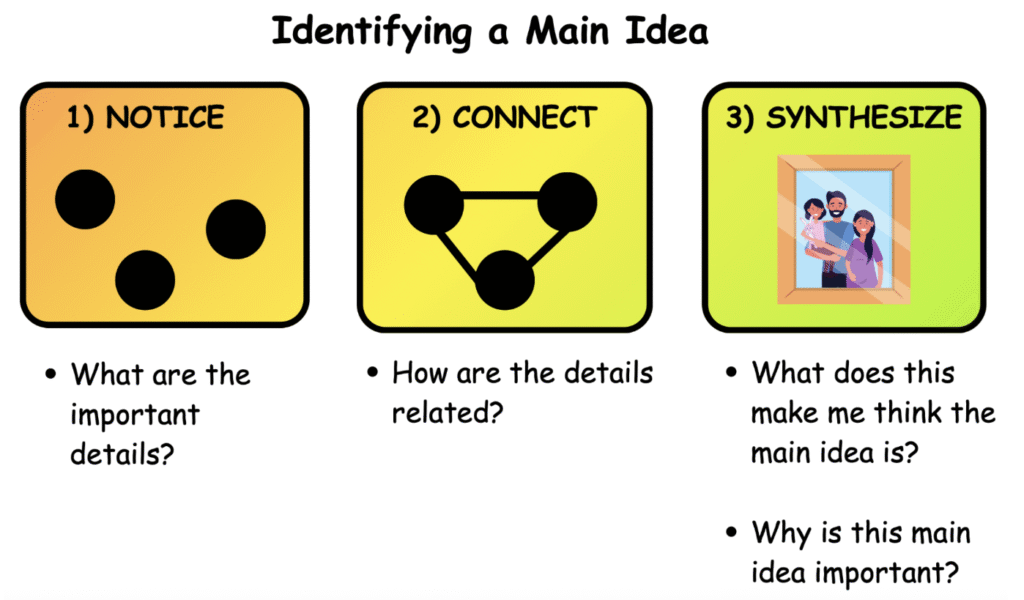
- Stating how to find the main idea – with an analogy to a framed photograph (or a screen saver photo on my phone) and an anchor chart for students to reference
- Engaging in an I DO & WE DO and then gradually releasing responsibility across lessons with multiple texts.
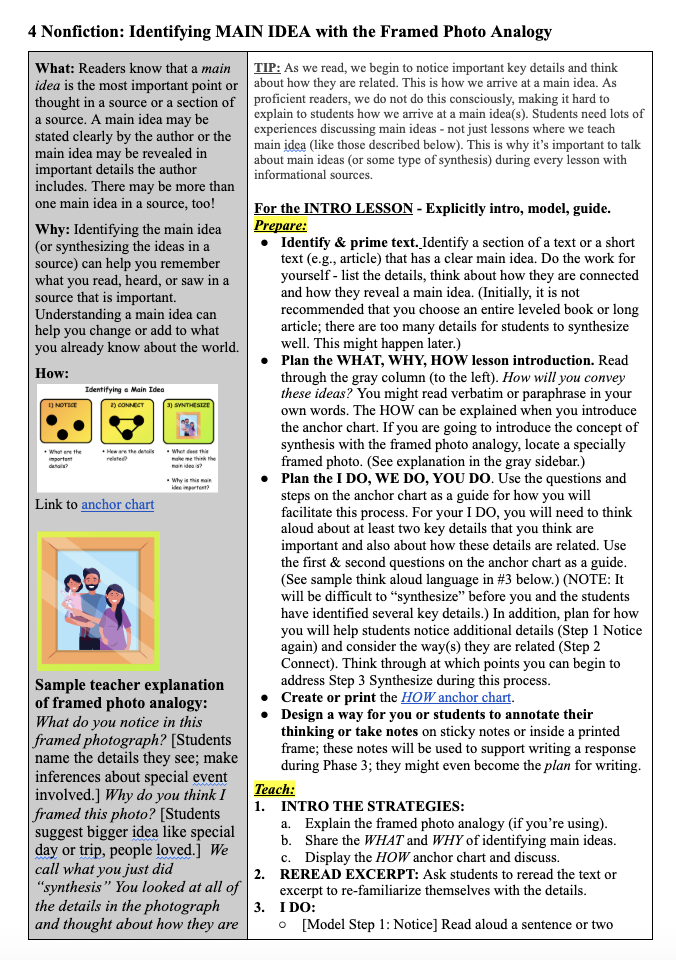
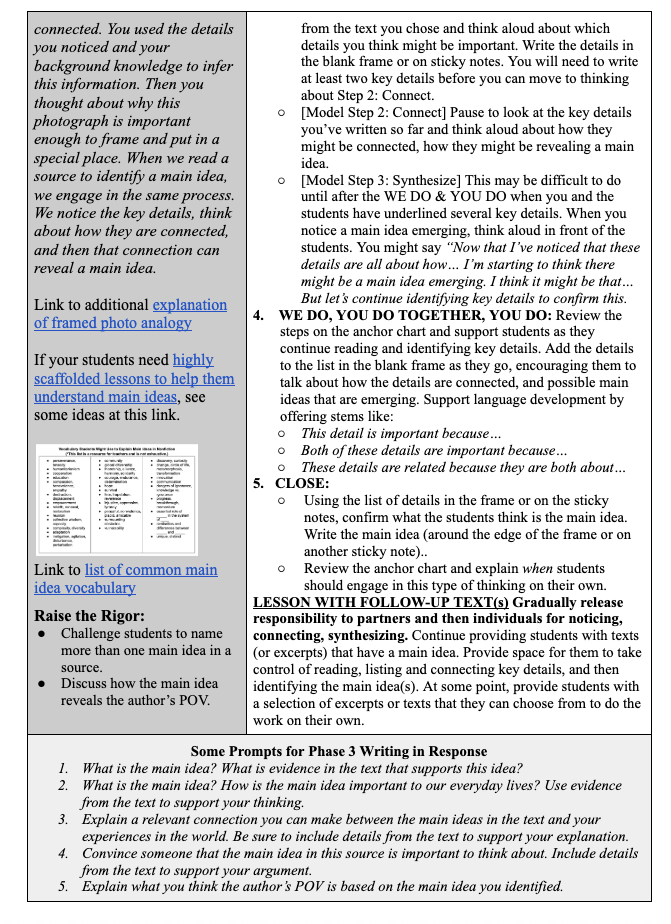
Two-Page Resource
This is a short comprehension module on teaching main idea. It includes language you can use to explain the what, why and how of main ideas as well as a link to a three-step anchor chart students can use to assist themselves as they make sense of key details and how they are connected in a way that reveals a main idea. In addition there are suggestions for how to teach main idea over the course of several lessons (gradually releasing responsibility) and a list of writing prompts. You might take a few minutes to review this before reading on.
A Sample Three-Phase Lesson
What follows is a description of a three-phase lesson we gave in Waukee, Iowa – a BIG THANK YOU to my colleagues there who helped me design and teach this lesson! We used the short book Flying Spies (Pioneer Valley Explore the World Series) We selected only a section of the text to discuss main idea; frequently talking about the main ideas in entire books (to start) is overwhelming for students. It’s totally okay to work with a section of the text only. The section we selected revealed a clear main idea.
Phase 1 Meet the Source
The teacher introduced Flying Spies (Pioneer Valley Explore the World Series) and let the students just read and enjoy the book. As the students read, the teacher engaged individuals in reading conferences. Afterwards, the teacher posed a higher level thinking question and they discussed.
Phase 2 Meet the Strategy
After the teacher taught phase 1, I demonstrated the phase 2 lesson. I introduced the vocabulary word “trained” – clearly defining, giving an example sentence and then asking the students to use the word in the sentence. Understanding this word would help us later when we closely read an excerpt. (If you need support choosing words to teach, visit my slide deck of Tier Two vocabulary.)
Then I explained the what and why of identifying main ideas. (This language is in the TWO PAGE GUIDE mentioned earlier.) This is super important for striving readers. They need to know exactly WHAT a main idea is and WHY they should bother identifying one ;).
Next I presented an analogy with a framed photograph of their teacher with a special person in her life. I started by asking the students, What do you notice? They identified the teacher, the special person, where they were, how they were leaning into each other as though they care about each other. I followed with the question, So why do you think your teacher framed this photo? The students developed some main ideas like this photograph represents a special relationship in her life, this reminds her of a remarkable event or experience, this helps her remember an outstanding person she was close to.
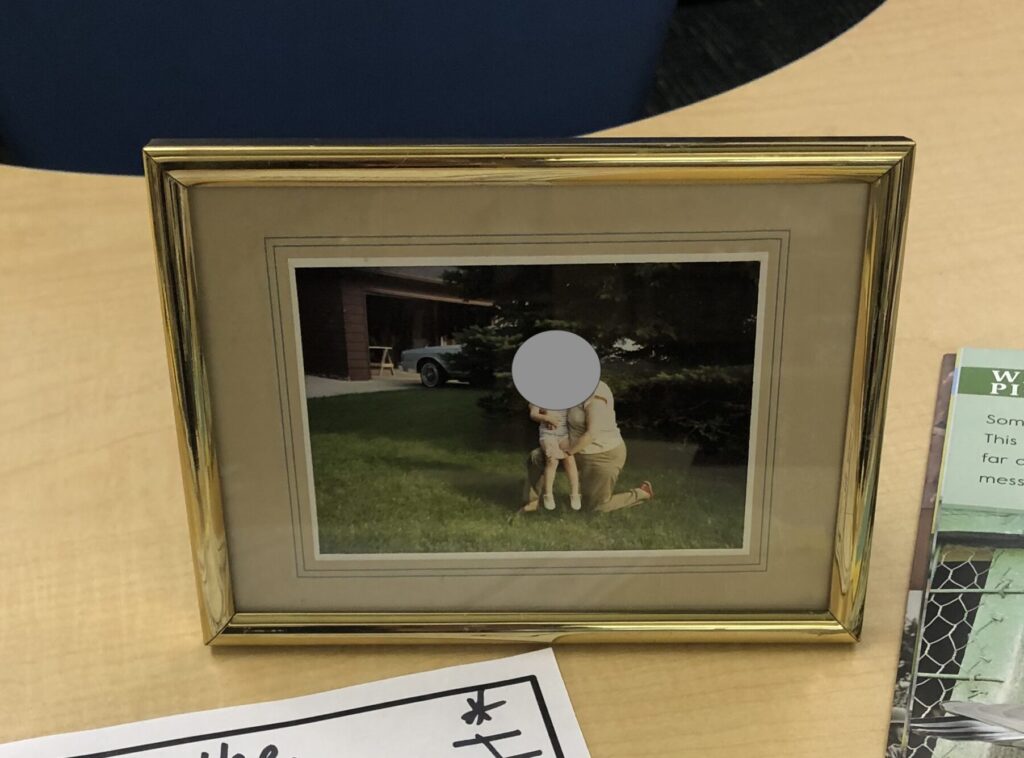
Then I stated explicitly what they’d done that is similar to how we identify a main idea in an informational source: We call what you just did “synthesis.” You looked at all of the details in the photograph and thought about how they are connected. You used the details you noticed and your background knowledge to infer this information. Then you thought about why this photograph is important enough to frame and put in a special place. When we read, view or listen to a source to identify a main idea, we engage in the same process. We notice the key details, think about how they are connected and then that connection can reveal a main idea. (Click to see more details about how to present this analogy.)
Next I introduced the HOW anchor chart. Striving readers benefit from clear steps for engaging in a particular type of strategic processing of text like identifying a main idea. See the anchor chart posted above. Notice three steps – 1) Notice 2) Connect 3) Synthesize. This chart presents easy steps (with guiding questions) to students.
Once we discussed these steps, we returned to Flying Spies and read the section “What are Homing Pigeons?” Next we started a close reading following STEP 1 on the anchor chart – looking for key details that would lead us to the main idea. To start, I thought aloud (I DO) about the first three sentences and decided that “trained to carry” was an important detail that might help me synthesize and identify a main idea; I jotted it down in a printed copy of a frame. (See my handwriting in the image below.) Then I drew the students into a WE DO; we read one sentence at a time, discussed and decided if there was a detail that might be important. As we did this, we jotted important details inside the frame. We continued with the WE DO until the last sentence when I asked the students to read and write a detail on their own (YOU DO). (See sticky notes in the image below.)
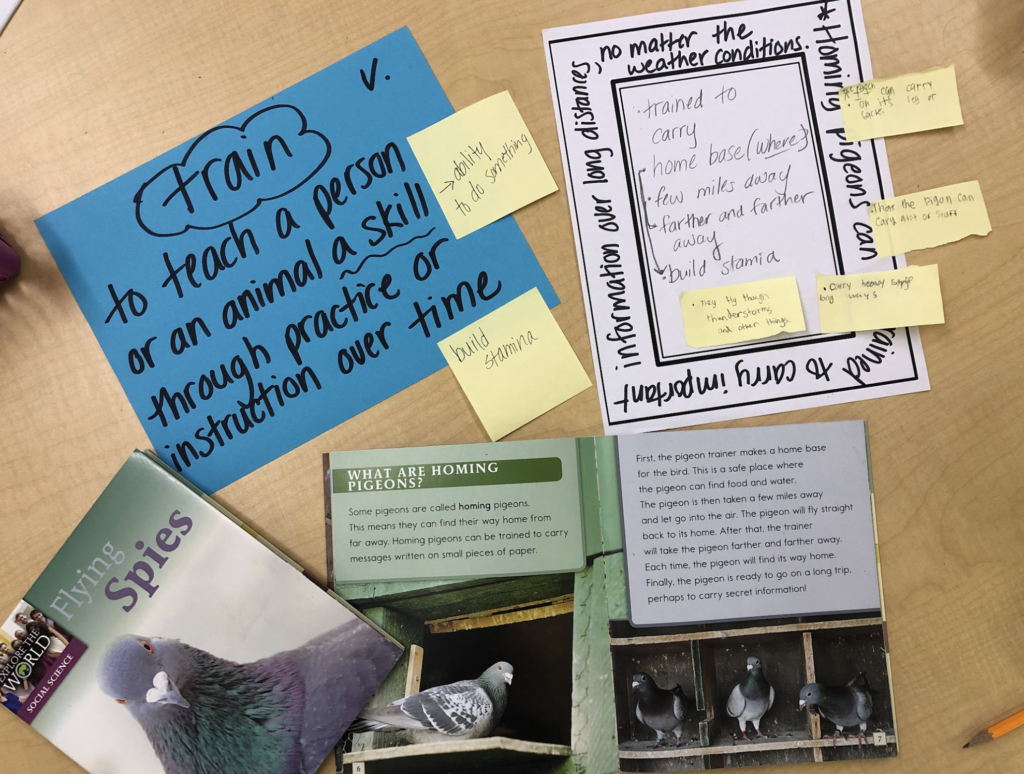
When we finished, we engaged in STEP 2 CONNECT with a WE DO. We looked at the key details and began to think about how they are connected. This led us to STEP 3 SYNTHESIZE. (See image with the main idea statement we identified written in the frame.)
In follow up lessons, students should have their own frames (YOU DO or YOU DO TOGETHER) and be responsible for writing their own key details and main idea statements (with support as needed). An ALTERNATIVE lesson for students who need an easier way to grapple with main ideas would be to give the students the main idea at the start (written around the edge of the frame). Then they can focus on the details and see more easily how they connect.
I closed by asking them to review EXPLICITLY WHAT WE DID TO FIND THE MAIN IDEA. My recommendation is to use the anchor chart as a visual.
Phase 3 Meet the Response
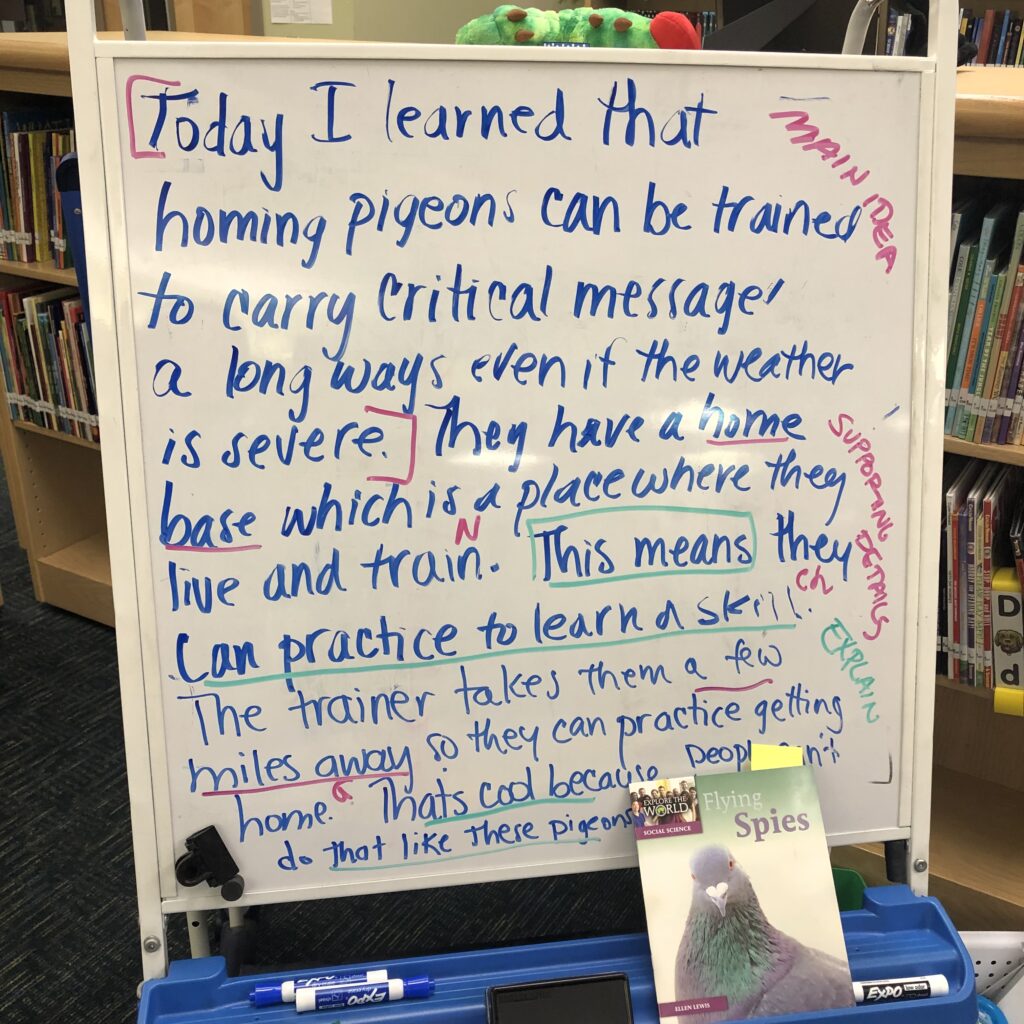
For this lesson, we used our notes in the printed frame to help us write a shared response summarizing what we learned and the main idea (WE DO). (See image below.) AGAIN – during follow-up lessons, students need to write responses on their own (YOU DO).
Teaching students to do this is not easy
Students need LOTS of opportunities to work on this. If they continue to struggle, you might check out some additional blog entries I’ve written that might be helpful.
- Give students the main idea up front and then let them grapple with identifying and explaining key details. Lots of experiences with already identified main ideas can help them begin to notice main ideas on their own.
- Unpack a main idea statement to help students explain a main idea better. Write the statement on piece of chart paper, discuss what the different words or phrases in that main idea mean and annotate. Step back and summarize what the main idea means using the annotations as support.
- Discuss the main ideas in a photograph. This eases the cognitive load for students.
- Identify the character traits of historical figures. This is a super easy way to help students think about main ideas in sources on history.
Hope this helps.
Sunday
Originally posted 2/17/2021
REVISED and reposted 1/29/2026